
Meet the young researcher trying to stop an invasive crab from threatening Pacific marine ecosystems
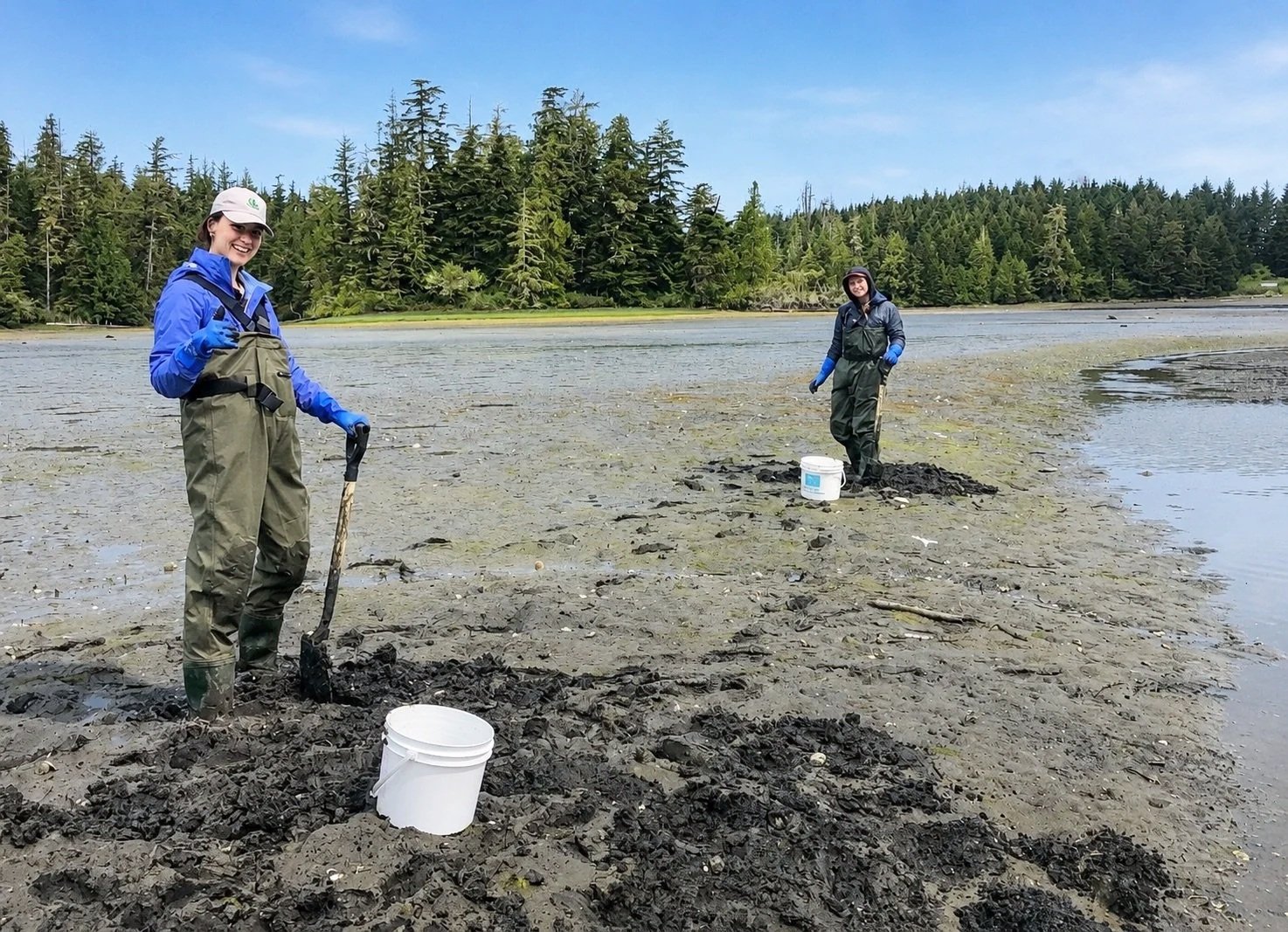
Sofia Panzetta and field assistant Erika Hawes collecting clams for experiments. Photo courtesy of Bamfield Marine Science Centre
By Patricia Lane & Sofia Panzetta
Sofia Panzetta is helping restore balance to Pacific marine ecosystems. As climate change warms the ocean, the invasive European Green Crab thrives, threatening the health of clams, mussels and even salmon stocks. Sofia won a Starfish Canada Climate75 Fellowship for her research showing us where we need to act to ensure our fisheries have a fighting chance.
Tell us about your research.
European Green Crabs do not belong on our coast. They were first seen in British Columbia in 1998 off Vancouver Island. Each female lays up to 185,000 eggs once or twice a year with a very high survival rate, credited to its high adaptability to changing temperatures and salinities. They are voracious and successful predators and, as a result, less than 30 years later, are outcompeting many native species and threatening our commercial salmon and shellfish industries. For my Masters in Science in Ecology degree at the University of Alberta, I developed maps showing which places on the coast of British Columbia are most vulnerable to the impacts of the growth of the European Green Crab population. My work is being published in two scientific journals to inform decision-makers and those who influence them to conserve our coast.
The European Green Crab is so embedded in these waters that eradicating it is not realistic. Even containing its growth will be expensive. But failing to do so puts our coastal ecosystems at risk.
Who do you hope to reach?
Indigenous Land Guardian programs and organizations, such as the Pacific Salmon Foundation and the Coastal Restoration Society, are doing really good work on this issue. I hope my research will strengthen their arguments for more funding. There is interesting work being done to develop commercial uses for the catch of these crabs, such as promoting human consumption, creating bio-plastics and even making a good whiskey out of them! But given the scale of the threat, markets alone are not enough.
READ MORE Free to read — no sign-in required.
Youth Climate Action
- September 2026 2
- August 2026 1
- July 2026 3
- June 2026 3
- May 2026 2
- April 2026 3
- March 2026 5
- February 2026 3
- January 2026 2
- December 2025 4
- November 2025 1
- October 2025 5
- September 2025 3
- August 2025 2
- July 2025 3
- June 2025 1
- May 2025 2
- April 2025 3
- March 2025 2
- February 2025 2
- January 2025 2
- December 2024 1
- November 2024 1
- October 2024 2
- August 2024 1
- July 2024 4
- June 2024 1
- May 2024 2
- April 2024 4
- March 2024 1
- February 2024 3
- January 2024 4
- December 2023 1
- November 2023 3
- October 2023 3
- September 2023 1
- April 2023 1
- February 2023 2
- January 2023 2
- December 2022 1
- November 2022 4
- September 2022 3
- August 2022 3
- April 2022 1